LSTM (Long Short-Term Memory)
Understanding LSTM architecture with gate mechanisms, forward pass implementation, and how it solves vanishing gradients compared to vanilla RNNs.
Paper Link
Code
import numpy as np

class LSTM:
    def __init__(self, input_size, hidden_size):
        self.input_size = input_size
        self.hidden_size = hidden_size

        # Initialize weights and biases
        self.Wf = np.random.randn(hidden_size, input_size + hidden_size)
        self.Wi = np.random.randn(hidden_size, input_size + hidden_size)
        self.Wc = np.random.randn(hidden_size, input_size + hidden_size)
        self.Wo = np.random.randn(hidden_size, input_size + hidden_size)

        self.bf = np.zeros((hidden_size, 1))
        self.bi = np.zeros((hidden_size, 1))
        self.bc = np.zeros((hidden_size, 1))
        self.bo = np.zeros((hidden_size, 1))

    def sigmoid(self, x):
        return 1 / (1 + np.exp(-x))

    def forward(self, x, initial_hidden_state, initial_cell_state):
        h, c = initial_hidden_state.copy(), initial_cell_state.copy()
        hidden_history = []

        for t in range(x.shape[0]):
            x_t = x[t].reshape(-1, 1) # (input_size, 1)
            concat = np.vstack((h, x_t)) # (hidden+input, 1)

            # Forget gate
            ft = self.sigmoid(np.dot(self.Wf, concat) + self.bf)

            # Input gate
            it = self.sigmoid(np.dot(self.Wi, concat) + self.bi)

            # Candidate
            c_tilde = np.tanh(np.dot(self.Wc, concat) + self.bc)

            # Cell state update
            c = ft * c + it * c_tilde

            # Output gate
            ot = self.sigmoid(np.dot(self.Wo, concat) + self.bo)

            # Hidden state update
            h = ot * np.tanh(c)
            hidden_history.append(h)

        return np.array(hidden_history), h, c
Notes
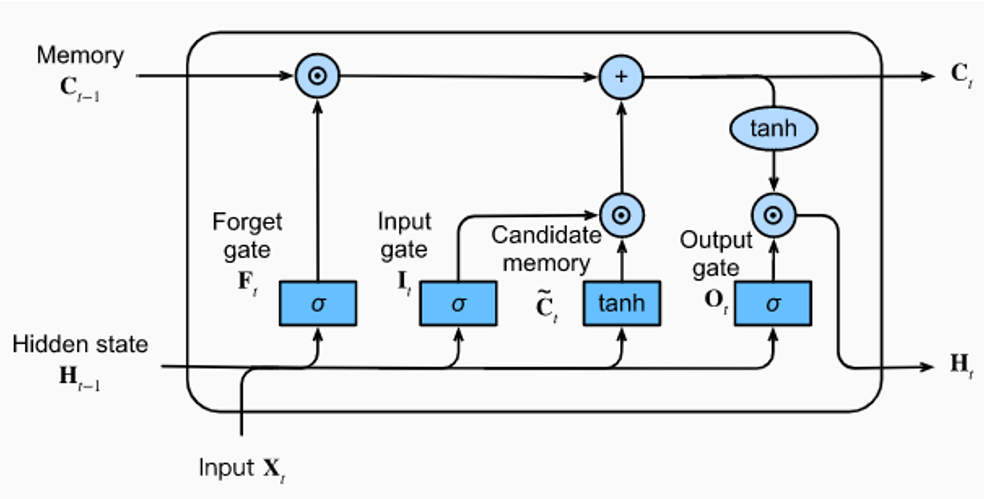
Image Credits: https://medium.com/@ottaviocalzone/an-intuitive-explanation-of-lstm-a035eb6ab42c
- An LSTM unit receives three vectors as input
- Two vectors (cell state and hidden state) were generated by the LSTM at
t - 1 - The input vector comes from outside and enters the LSTM at
t
- Two vectors (cell state and hidden state) were generated by the LSTM at
Understanding the Gates
The LSTM uses three gates to control information flow, each serving a specific purpose in managing the cell's memory.
-
Forget Gate: Decides what information from the previous cell state should be discarded.
- .
- Output range [0, 1] via sigmoid (1 = keep, 0 = forget).
- Basically uses the previous hidden state and input vector to decide what to "forget" from the cell state
- Example: Discards irrelevant information like "the mat" when no longer needed.
-
Input Gate: Controls what new information should be added to the cell state in two steps:
- As seen from , candidate memory proposes new content and input gate decides how much of it to use
- Decision: What values to update?
- Candidate: New values to add? Sigmoid decides which values to update [0,1], tanh creates candidates [-1,1]. Example: Stores information about "the cat eating" when relevant.
-
Cell State Update: Actual memory update combining forget and input: where is element-wise multiplication.
- First term keeps old memory, second adds new info. Additive structure prevents vanishing gradients.
-
Output Gate: Decides what parts of cell state to expose as output: , .
- Applies tanh to cell state [-1,1], then filters output. Example: Exposes only relevant attributes like "hungry" for prediction.
How LSTMs are an improvement over vanilla RNNs
-
Vanilla RNN Problem: Traditional RNNs suffer from vanishing/exploding gradients due to multiplicative updates:
-
LSTM Solution: LSTMs use additive cell state updates instead:
-
Gradient Flow: During backpropagation, gradients flow more easily: Since , gradients neither vanish nor explode completely, allowing long-term dependencies to be learned.
-
Gates Learn Importance: Unlike vanilla RNNs that treat all history equally, LSTM gates learn what information to keep, forget, or emphasize at each timestep.