Kosaraju Variants
Kosaraju's algorithm finds all strongly connected components in a directed graph in O(V + E) time using two DFS passes: first to order nodes by finish time, then on the reversed graph to identify each SCC.
Introduction to Strongly Connected Components (SCCs)
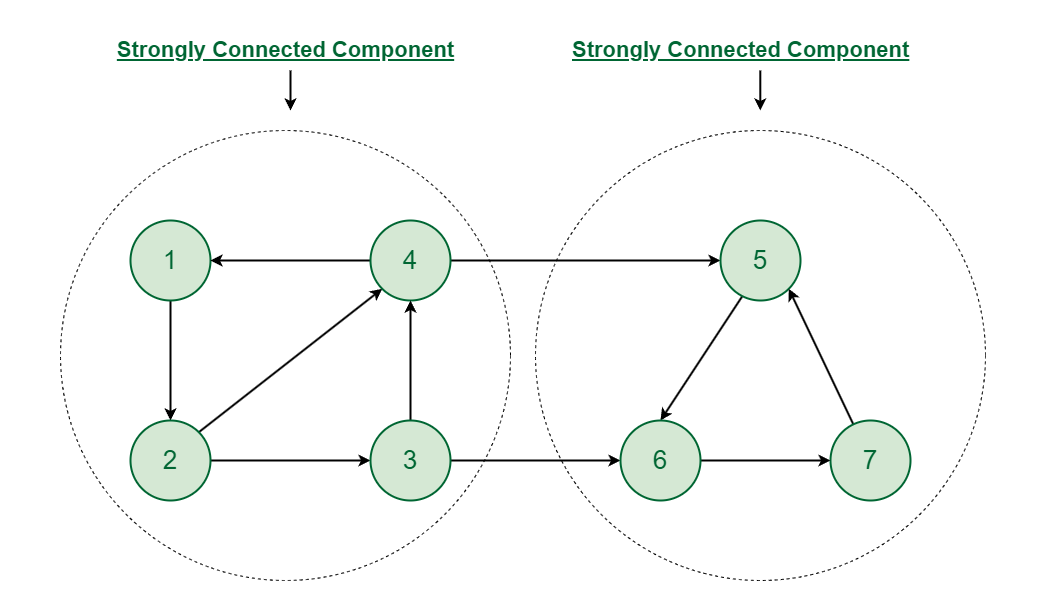 Image Credits: https://www.geeksforgeeks.org/dsa/strongly-connected-components/
- Strongly Connected Components (SCCs) are maximal subgraphs within a directed graph where every vertex is reachable from every other vertex in the same component
- Within an SCC, a bidirectional path exists between all pairs of nodes
- If a node cannot reach any others, it forms its own SCC
Variant 1: Count Number of SCCs
How Kosaraju's Algorithm Works
-
Core Idea: Uses two passes of Depth-First Search (DFS) to identify all strongly connected components in a directed graph
-
Step 1 - First DFS Pass (Original Graph):
- Perform DFS on the original graph starting from any unvisited node
- Track the order in which nodes finish their DFS exploration
- Store nodes in a stack or list based on their finish times (nodes that finish later are added last)
- This ordering ensures that nodes in earlier SCCs finish before nodes in later SCCs
-
Step 2 - Graph Reversal:
- Create a reversed graph by flipping all edge directions
- If there was an edge from u to v, now there's an edge from v to u
- This reversal preserves SCCs (nodes strongly connected in the original graph remain strongly connected in the reversed graph)
-
Step 3 - Second DFS Pass (Reversed Graph):
- Process nodes in reverse finish order from Step 1 (start with nodes that finished last)
- Perform DFS on the reversed graph for each unvisited node
- Each DFS traversal in this step discovers exactly one SCC
- Count the number of times a new DFS is initiated to get the total number of SCCs
-
Why It Works:
- The first DFS creates an ordering where if there's a path from SCC A to SCC B, then nodes in A finish after nodes in B
- Processing in reverse order on the reversed graph ensures we explore each SCC independently
- The reversal prevents crossing between different SCCs during the second DFS pass
-
Time Complexity: O(V + E) where V is the number of vertices and E is the number of edges
-
Space Complexity: O(V) for storing the finish order and reversed graph
Playground: Kosaraju walkthrough
Kosaraju walkthrough
Step through both DFS passes, watch the finish order stack form, and see how SCCs appear in the reversed graph.
Pass 1: start DFS from A.
Original graph
Adjacency lists
Original
Reversed
Finish order (bottom to top)
Processing order (top to bottom)
DFS stack
Strongly connected components
Use the step controls to watch the first DFS build the finish order stack, then switch to the reversed graph to see each SCC get collected in pass 2.
Code (C++)
int kosaraju_count_scc(const vector<vector<int>>& adj) {
    int n = adj.size();
    vector<bool> vis(n, false);
    vector<int> order;
    order.reserve(n);

    // 1) DFS to build finish order
    function<void(int)> dfs1 = [&](int u) {
        vis[u] = true;
        for (int v : adj[u]) {
            if (!vis[v]) dfs1(v);
        }
        order.push_back(u);
    };
    for (int i = 0; i < n; i++) {
        if (!vis[i]) dfs1(i);
    }

    // 2) Build the reversed graph
    vector<vector<int>> radj(n);
    for (int u = 0; u < n; u++) {
        for (int v : adj[u]) {
            radj[v].push_back(u);
        }
    }

    // 3) DFS in reverse finish order on the reversed graph
    fill(vis.begin(), vis.end(), false);
    int scc_count = 0;
    function<void(int)> dfs2 = [&](int u) {
        vis[u] = true;
        for (int v : radj[u]) {
            if (!vis[v]) dfs2(v);
        }
    };
    for (int i = n - 1; i >= 0; --i) {
        int u = order[i];
        if (!vis[u]) {
            dfs2(u);
            scc_count++;
        }
    }

    return scc_count;
}
Code (Python)
def kosaraju_count_scc(adj):
    n = len(adj)
    vis = [False] * n
    order = []

    # 1) DFS to build finish order
    def dfs1(u):
        vis[u] = True
        for v in adj[u]:
            if not vis[v]:
                dfs1(v)
        order.append(u)

    for i in range(n):
        if not vis[i]:
            dfs1(i)

    # 2) Build the reversed graph
    radj = [[] for _ in range(n)]
    for u in range(n):
        for v in adj[u]:
            radj[v].append(u)

    # 3) DFS in reverse finish order on the reversed graph
    vis = [False] * n
    scc_count = 0

    def dfs2(u):
        vis[u] = True
        for v in radj[u]:
            if not vis[v]:
                dfs2(v)

    for i in range(n - 1, -1, -1):
        u = order[i]
        if not vis[u]:
            dfs2(u)
            scc_count += 1

    return scc_count
Variant 2: Find Size of Largest SCC
- Slightly modified variant that instead keeps track of the largest SCC
Code (C++)
int kosaraju_max_scc_size(const vector<vector<int>>& adj) {
    int n = adj.size();
    vector<bool> vis(n, false);
    vector<int> order;
    order.reserve(n);

    // 1) DFS to build finish order
    function<void(int)> dfs1 = [&](int u) {
        vis[u] = true;
        for (int v : adj[u]) {
            if (!vis[v]) dfs1(v);
        }
        order.push_back(u);
    };
    for (int i = 0; i < n; i++) {
        if (!vis[i]) dfs1(i);
    }

    // 2) Build the reversed graph
    vector<vector<int>> radj(n);
    for (int u = 0; u < n; u++) {
        for (int v : adj[u]) {
            radj[v].push_back(u);
        }
    }

    // 3) DFS in reverse finish order on the reversed graph, tracking component sizes
    fill(vis.begin(), vis.end(), false);
    int max_size = 0;
    function<int(int)> dfs2_count = [&](int u) {
        vis[u] = true;
        int cnt = 1;
        for (int v : radj[u]) {
            if (!vis[v]) cnt += dfs2_count(v);
        }
        return cnt;
    };
    for (int i = n - 1; i >= 0; --i) {
        int u = order[i];
        if (!vis[u]) {
            int sz = dfs2_count(u);
            max_size = max(max_size, sz);
        }
    }

    return max_size;
}
Code (Python)
def kosaraju_max_scc_size(adj):
    n = len(adj)
    vis = [False] * n
    order = []

    # 1) DFS to build finish order
    def dfs1(u):
        vis[u] = True
        for v in adj[u]:
            if not vis[v]:
                dfs1(v)
        order.append(u)

    for i in range(n):
        if not vis[i]:
            dfs1(i)

    # 2) Build the reversed graph
    radj = [[] for _ in range(n)]
    for u in range(n):
        for v in adj[u]:
            radj[v].append(u)

    # 3) DFS in reverse finish order on the reversed graph, tracking component sizes
    vis = [False] * n
    max_size = 0

    def dfs2_count(u):
        vis[u] = True
        cnt = 1
        for v in radj[u]:
            if not vis[v]:
                cnt += dfs2_count(v)
        return cnt

    for i in range(n - 1, -1, -1):
        u = order[i]
        if not vis[u]:
            sz = dfs2_count(u)
            max_size = max(max_size, sz)

    return max_size